I am in one of the perhaps less optimistic phases of my life...three months unemployed after the end of my contract on OpenLearn looking for the relatively rare jobs that seem to match my skill set. I am also working on the PhD. One would think with the extra masses of time that I would have really striven towards this but all I have done in this three months is completed one chapter in draft form. Admittedly, chapter 6 and 12000 words, which I guess is 15+ percent of the thing, admittedly a difficult chapter...but they are all difficult...every single damn one of them.
I am also in a bit of a self-doubt phase...where is the golden apple, when will the goose lay the golden egg, where is the flash of brilliance? Or is it simply a necessary text giving me a 'license to practice'...but where and what to practice? I cannot for instance teach mathematics education because despite 17 years teaching practice and a potential PhD, a Masters in Statistical Education I do not have a teaching certificate....one of my numerous Achilles heels. Sometimes I feel like....one giant Achilles heel (I am re-reading the short story 'The Nose' by Chekov at the moment where the guy loses his nose and the nose sets iteself up as an imposter taking over his life etc...I wonder if this is an example of early magical realism...never worked out what exactly that is).
When I left my job as a lecturer I was taking a risk because I knew I was chained down by my work...has that risk paid off...yes and no? Pluses and minuses. Perhaps if I have learned one thing - I should have probably taken the risk about seven years earlier than I did. This moment of time perhaps represents one of the low points of the risk...where I am even considering temporary Christmas work like at Sainsburys. Where I am even considering whether continuing to research education and eLearning is the right thing. In a documentary about Hendrix the other day he was broke, unknown and out of work when he came to London....mind you he was a formidible talent.
As a contract research I no doubt share these feelings with many others. Indeed a friend of mine was on the dole for 8 months before finding new work. Who knows. This is all part of the risk....after all I am not the only person who has gone through this phase...I just feel at my stage of life I should have metaphorically (and in reality) stocked up more money in the bank...though in this age this is probably not a very suitable or secure metaphor.
Anyhow...metaphors are an important part of my PhD, and metonomy.
Spoke to my friend Gill today, a fellow sufferer and a past contibutor to this blog, this has helped me and indeed I was able to get an hours PhD work done today (albeit just reading an earlier chapter and making a few notes) after a two week desert of activity. A chest infection and the glumness of the weather has not helped.
Still, I ultimately remain optimistic and know my PhD will come to some kind of conclusion and perhaps I will fufil a life time's ambition (after all I'm just from a secondary modern school)...this is the story of the final stages of that ambition...the crawl through the slough to....the chance meeting at the Cross Roads, guitar in hand with wordly goods wrapped up in a piece of leather....a glint of light shimmering every once and a while through the darkness of the thrashing rain....
Tuesday, November 04, 2008

Friday, July 04, 2008
ED-MEDIA 08 Vienna - 1 Example of Talk
Thinking about thinking through multimedia - talk by:
Nicholas Reynolds from the Univ of Melbourne.
This was a study on pre-service teachers.
A task was developed modelled of sound constructivist principles where students had to create a program using microworld and reflect on this process in terms of teaching.
The students were generally passive computer users - not engaging with trying to make the computers do something for them. Were not seen as 'digital natives'.
Their task was to construct a multimedia project- a story, book, a game. ...introduced Microworld was introduced through workshops and lectures to help engage student thinking - over five weeks. Workshops at low skills level. Nicholas was presenting three years of work in this area...Year 1: students became v.engaged so decided to pursue research, varied from year to year. Reflective component - in final year there was a reflective diaries and interviewed users.
One very funny multimedia presentation was The Old Lady Who Swallowed a Fly - animated sequence presented of a woman swallowing a fly followed by swallowing a cat, followed by cow and horse.
Some:
- Frustration with MicroWorlds
- struggling with perfectionism
- could not express big ideas
One teacher said she spent a long time to make a relatively short selection of material....she felt that it would help her relate to students in the classrooms.
Another demo to music of Hnadel (I think) - Angry Ants Ate Apples
One student reflecting on task said "This is conguent withboth scaffolding and constructivist theory "
Studnet illustrated and reflected on task drawing from theories of scaffolding with Bruner and Vygotsky--
Makes them explore the programme. Task helped training teachers to understand the importance of constuctivism in task design.
Papert - "You can't think about thinging withouth thinking about something. Coming up about meaningful insights"
Tuesday, June 24, 2008
TEL Away Day - SocialLearn - afternoon
The first part of this afternoon session started with Martin talking about the concept of SocialLearn, a new initiative being explored by the Open University.
SocialLearn will provide a space for users to pull together their own learning events into an open API. Associated with this there will be a set of learning applications. Links will be provided to systems such as COHERE, CLOUDWORKS, MICROLEARNER, TWITTER, FACEBOOK, OPENLEARN, 2Learner...some developed in house and others externally available.
This is aimed at:
informal learners
students in formal education
educators for the creation of content
partners selling services and content
geeks - to play with Open API
vocational learners
'Creepy treehouse' - an academic tries to become your friend on Facebook - the jumping on the young peoples' use of social networking tools - distinguishing between, personal, institute, and inbetween zone.
Move away to give focus on student control over their own learning....letting go... a lot more bottom up...
Do we end up creating our nightmare competitor? We need to take that risk to a certain extent.
Question of duplication with OU VLE? Applications will plug into it e.g. mystuff...idea of putting together lots of things...'edu glue'
Activities
In this section we looked at the suggestions made by people in the room for learning activities. Here we were given the opportunites to read others and give them a rating. It looks like Canan's got the highest rating...this was where a teacher would do something dramatic in front of the class and then there would be a period of interpretation.
Mine seemed to be rejected..which did no surprise me - probably did not like the terms repetition and variation and missed the point... I would love to be able to learn a poem easily - the question is how can one do this? Based on work of Marton.
Idea behind cloudlets is to do with simple ideas. How on earth does that kind of thing happen? Is a good method of doing things...scaling up.
Patrick mentioned 'neat little ideas that worked' and martin about some ideas that work..social objects, but I feel that something is missing.
The idea of scanning all the bar codes from peoples' books was suggested so that we could have some kind of lists of all the books that were available within the department. Since the department is moving into a new building these things would become possible. Of course I probably won't be moving anyway.
TEL Away Day - Morning - eTools
Away day for our section within IET -
TEL - Technology Enhanced Learning.
In the first part of the session we divided into groups to discuss the various tools such as Wikis, Twitter, blogs.
Martin reported back from our group about Wikis - we felt there should be a clear focus for their use e.g. to support meetings where people can add to or correct texts.
Eileen reported on Twitter: what would you use it for? the barrier between work and other parts of your life...Twitter however was considered a safer area. Eileen liked the brevity of it. Patrick commented on the life-work boundary, conversations of which were more likely to occur over coffee...in our case me, Agnes and Doug discussed Richard Dawkins. I said I disliked his manner, felt he did not argue his points very well, and was pompous.
Doug - distinguished between social use and work-based used. Do tools like Twitter help to 'get work done'.
Patrick aiming to get five point action plan:
- let's give twitter a try - no cohersion, a place for people to gather
- encourage people to blog - can be put into aggregator
- have a look at Cohere and Compendium
- have a look at telsns.ning.com
Martin: Broadcast strategy review followed by a self created movie. Concept of Edupunk. ...Everything is Miscellaneous, David Weinberger
Broke up into groups: discussed what makes people get involved with these tools...why do people choose certain tools and not others? How we might present PhD thesis on FlashMeeting.
Question about whether people read the notes made at meetings.
Questions of quality raised by Anne - also issues of being 'extra work' but as educational technologists we had to do it. Issue of needing the extra support to help us develope these skills.
Issue of quality is an area which often comes up in these talks - BBC quality is virtually unattainable but the 'rough video' thing can work and give something different. These are probably skills that we need to develop. Martin talked about the motivation that he had where he was doing it for fun. Robin talked about making little audio and video clips and how these can make things more interesting.
It' great that we can feel free to type and use computers at the same time as the talk is going on.
Thursday, October 25, 2007
Neat handwriting = Poor Literacy?
Cognitive Overload and Automation
http://www.channel4.com/news/articles/society/education/not+so+neat+solution+to+literacy/956247
Something to ponder. In an interesting report based on research at Warwick University they suggested that too much focus on neatness and correct formation of letter forms got in the way of developing literacy skills since mental effort was directed toward the forming of the letters rather than writing itself and its creative process. By abandoning worry about forming the letters automation of writing could come about more quickly freeing up the mind for higher level creative processes. This reminds me too of advice on speed writing where the ‘internal editor’ with its attention to grammar, spelling and structure is temporarily turned off to allow creative thoughts and ideas to flow. The argument is that this reduces congnitive load. The area of automation through practice and examples is also an important part of my PhD work.
Ontology, Ontology and Ontogeny
These words continually present me with a muddle. Lets start with Ontogeny which has been described as ‘the origin and development of an individual organism’ OED. Now Engestrom and Cole talk about the ontogeny of the individual when describing the various timelines surrounding an event. By this they mean their personal life story and history. They also talk of other timelines in which events are embedded namely social-cultural, historical, and phylogenetic. The moment to moment happenings within an event are referred to as microgenesis. The problem I have with Ontogeny is not its meaning but using the right word. I continually refer to it as Oncology and sometimes Ontology. Life is tough! Ontogeny and Ontology are very similar so easy to muddle.
Ontology and ontological present me with some problems and even now I am some time away from being able to use these terms automatically…incidently really interesting to hear report today on automaticity in learning to read. The woman from Warwick said that children were slowed down in their skills in fluency of writing because of the concentration on neatness… I can very much believe this. It was a typical example of cognitive overload – which they alluded to but this term was not used on the channel 4 report.
I think that part of the problem of using these terms lies in the fact that there are two distinct meanings:
i. ‘the science and study of being’ – a metaphysical perspective – I will look up definition from Theory of Knowledge
ii. and in logic and symbolisation based on the work of Lesniewski (1886 to 1939) ‘which attempls to interpret quantities without assuming that anything exists beyond written expressions’. It is in this sense that I think Sfard is probably using this word in her chapter…..
Wednesday, August 22, 2007
Methods and Methodologies - What's the Difference?
I have recently read "The Erosion of a method: examples from grounded theory", a paper by Thomas Greckhamer and Mirka Koro-Ljungberg. It is a useful critique of Grounded Theory but is equally relevant to any research methodology.
All research methods it seems to me have at least one significant Achilles heel. The authors perhaps suggest that Grounded Theory was under-theorised in terms of its epistemological foundations although the its methods are quite clearly defined.
The authors state that they 'agree with Crotty (1998) who defines methodology as the 'strategy, palan of action, process or design lying behind the choice and use of particular methods and linking the choice of methods to the desired outcomes'.
They state that the main outcome of Grounded Theory is theory generation (as opposed to testing a theory for example) and the chosen methods, coding, sampling, memoing etc, are the link from the data to the theory.
They also state another view of methodology as having a guiding theory or theoretical perspective on the research project.
Later the authors state, in terms of the original form of grounded theory, that it was essentially positivist in nature. Later on other versions of Grounded theory came into existence such as one that used constructivist notions. In this sense the theory is not grounded in the data but grounded in the researchers analysis and interpretation of the data. Hence instead of only one theory describing and predicting the data there may exist many. Since I do not believe in objective reality as existing independent of our interpretation of the world I am taking the constructivist's view as the underlying theoretical approach to adopt in my PhD.
Thus, have I now secured the methodology. Maybe? I think Maxwell 'Qualitative Research Design' will be worth turning back to: chapter 1 - A Model for Qualitative Research Design and Chapter 3 - Conceptual Framework? What do you think is going on?
Thursday, June 28, 2007
Fun and Frolics with Mobile Devices - by Gill Clough
A tag cloud is pretty easy to put into a blogger blog. This post explains very clearly how to go about it
http://phy3blog.googlepages.com/Beta-Blogger-Label-Cloud.html
My overall PhD title is "The uses of mobile devices in informal science learning", however I think Fun and Frolics with mobile devices is rather more descriptive of what I do. I am looking at how Geocachers engage with their physical and social contexts using their devices, and with each other through the active online community network.
Geocaching involves taking mobile devices with GPS (global positioning systems) out and using the technology to locate caches. Caches are like hidden treasure, hidden by other geocachers. Not all caches are physical objects; some are virtual caches, some are multi-caches where one cache leads to the next by enabling you to solve a piece of a riddle, some are "earthcaches" which have a strong learning focus. To bag an earthcache, you need to demonstrate that you have learned something about the geological processes that formed that part of the landscape, as specified by the person who set the cache. Geocaching attracts thousands of participants world wide, and their enthusiasm makes them ideal and very willing participants in my research.
To read more about Geocaching, check out this wiki
http://wiki.geocaching.com.au/wiki/Main_Page
Visit the main geocaching website at http://www.geocaching.com to see examples of how you locate caches near you, load the coordinates into your GPS device and head off out. You can also read about other people's experiences of caching.
Monday, June 25, 2007
Welcome to Gill
It's great to have Gill as my guest blogger...love the picture - you must be geocaching!....and already I am shamed by the lack of facilities on my site....I want one of those cloud thingymajiggs Gill!
Anyhow, Gill is the first of hopefully many guest bloggers in the future. Gill is working toward a PhD in our department, Institute of Educational Technology at the Open University. She is also an active member of our OpenLearn reading group which is currently involved in discussing readings relating to methodological approaches that we can use in examining eLearning. I know In her own researchGill is very interested in Mobile Learning and Blogging.
Gill perhaps you would like to answer a few questions.
Would you like to talk a little bit about your research work?
Have you any favourite links you would like post?
Can you tell us a bit about tagging?
Thursday, June 21, 2007
Guest Blogger

Steve has invited me to be his guest blogger for the week. It feels like quite a responsibility; I'm now wondering if I have anything worthwhile to contribute.
I logged in for the first time today and discovered that Steve's blog uses exactly the same template as I use for my own blogspot blog which makes it rather like a home-from-home.
Except, of course, that this blog does not have a tag cloud or snapshot (to display a mini version of links). I just looked into creating a tag cloud for this blog, and discovered that is doesn't use any tags.
Still, Steve can always add snapshots to this blog by visiting here http://www.snap.com/
Monday, June 18, 2007
Automation - ein hundert vier and zwanzig
As part of my work in OpenLearn I am exploring a potential project to help pre-university students to develop their Mathematics skills. I am looking at a possible project with the Physics department at the University of Bristol. The people there are exploring ways to help equip people for the course in advance and have identified the need for some to be able to develop ability in the application of their Maths skills.
Another problem that they identified with students was the ability to quickly follow a mathematical line of argument, whether this be in rearranging equations, solving a problem etc. It was not that the students did not understand the mathematics but they could not keep speed with the process...a kind of taking time to read and understand, so by the time they had mentally grasped one bit the lecturer had moved on by several steps.
I liken this to my knowledge of translating and understanding spoken German, especially when it comes to numbers. I pretty much can construct any German number, and given time, if it is slowly spoken, understand a number. The problem comes when I hear a number in general conversation, by the time I have worked out what the number means the person talking has moved on with the conversation and I have totally lost the thread. For me understanding the number is not automatic. The word automatic was also used by Prof K and Dr P when relating to some of students' experience.
I recently read something about this automation in a book about activity theory and we discussed it briefly in our reading group. At the time I said that I considered it to refer to those processes that involved a lot of physical skills, such as the high degree of muscular tuning and control necessary for playing an instrument. I related the example from the BBC documentary were Waugh (forgotton his first name) learns a one-handed Chopin piece and reads a book aloud whilst playing the piece with his other hand.
To be continued.....
Tuesday, June 05, 2007
Generating Analytical Memos by Free Writing
Following on from a wonderful exercise in Engaging Minds and having read and heard about speed writing as a way of getting ideas I have engaged with the exercise below. I have re-adapted part of the writing task in Engaging Minds to begin to help me think about ways of drawing together the various ideas from an examination of the chapter that I am writing in my PhD.
Now that I am nearing the completion of this draft chapter I will need to bring the various threads and themes together.
Activity: Write freely for 5 minutes about the threads and themes that you think are emerging. There is no need to look back, correct, pause and worry about sentence structure.
Relax.
Don’t rush…but do not stop and edit.
There appear to be several emerging themes that I can connect with ideas of embodied mind and the development of mathematical understanding through metaphor and examples. Students, I believe are more likely to reach understanding by examples although Vinner stresses the need for a mix of example and definition. Which comes first the chicken or the egg…. the examples or the definition…how does the concept get formed…is there every such a thing as a concept being fully formed or does it simply evolve and change in our minds as we evolve and change as individuals. Certainly when I taught basic mathematics to students I saw things that I had never seen before, and learned a lot more about mathematics. When I went on to do research into mathematics education and interact with the mathematics community I learned anew and saw afresh and began to ask questions about the nature of mathematical knowledge, know how and ability.
The path schema emerges fairly strongly from the data…but several others also do so. I think of the nature of physical movement, and how this is represented within the graphs…the personal nature of it all.
(191 words in five minutes)
I will need to continue this tomorrow and hope that ideas will come from it. If you wish to interact please leave your comments. These could help stimulate my thoughts further.
Monday, February 05, 2007
Reading and Writing 1
The other day I was thinking about the relative merits of reading badly written and boring texts, that however may be important and hold key ideas. It is a bit like reading a boring, badly written novel and pursuing it to the bitter end - the amount you read drops considerably. I used to have the idea that if I couldn't get into a novel within 50 pages that I should give up on it. The problem with this is that sometimes great novels are difficult to engage with...I could never engage with Jane Austin but still feel I should read her.
When it comes to academic literature it can sometimes be rather dense and boring. The question is whether you drop what you are reading and search around for something that is an easy read...very often these will talk about the same ideas anyway and you would consume much more.
I also recently came across 'Researchers, Reflexivity, and Good Data: Writing to Unlearn' by Audrey Kleinsasser 2000. She referred to a quote from Richardson in the Handbook of Qualitative Research - ed. Denzin ( which I just the other week got out of the library) who also talks about this problem.
For the time it takes to force myself through one drudge I could perhaps read four times more of other more exciting material. The difficulty is that the drudge can hold important gems. I guess when it comes to papers you do have to wade through some of tough ones...although books are much lengthier matters and perhaps the choice should rather be made on readability.
Sometimes academics make things seem more complicated than they actually are and please give me down to earth examples of what you are talking about.
Tuesday, October 17, 2006
Two Reports and a Presentation for Tomorrow
It's been a stressful couple of days and I still need to pull off two reports from the Open Learn project and give a presentation for tomorrow. It is 10:25 pm and I am not way near completing these at present.
The reports relate to the first content and tools trials of the OpenLearn project. The talk will be centred around the Melon project. This is going to be a difficult one!
Any advice?
I am going to have to do a lot of cutting and pasting I think - I will have to sacrifice being able to do what I would really love to do.
We did trials on two of the tools that we will be using in the LabSpace namely Compendium and FlashMeeting. I found it quite good fun to use FlashMeeting. I would still like to use Compendium a bit more and perhaps find ways of using it for qualitative analysis. It is a sort of mapping tool and can be used to express relationships between ideas.
Well let's see what happens....
Friday, September 22, 2006
The Learning Bubble
This will be my first attempt to try to explain an idea of mine which I will call the learning bubble. It is based on a number of ideas:
- the human mind continually changes and this change includes the formation of new neuronal links, neurone regrowth and change, besides non-physical organisational changes
- when it comes to learning it is the context that is important
- nurture rather than nature
- immersion - daily lived experience
The model of learning it attacks is that learning is something that accumulates over time i.e. as we get older we 'know' more or become more experienced...experience being interpreted as being better to deal with our current environment.
Within this model I perceive the individual as existing within a time bubble and it is the recent learning that is more relevant to that individual's experience. We can perhaps imagine a time bubble of about three years in size. This bubble contains within it a number of learning experiences which are more likely to be relevant to the current context of the individual. Taking Ericssons idea's of expertise, if the experiences are intense or immersive enough there can be significant changes in individuals.
Let's take a psychomotor example: learning a tune on a musical instrument. I may learn a tune off by heart but if I don't play it for a while, even a couple of weeks, it needs revision before I can play it. A short spell of revision may make it playable again...but it is the currency of playing and doing it that counts...it has to be almost there at your fingertips.
The other day I played my first squash game for a long time, years, and I have not really played a great deal since my early twenties. I can still play, I know the skills are still there but they are not as yet at anything like the level they were.....or are they all there, but dormant? Is it a question of re-working and re-jeuvenating synapses, neuronal channels etc. How much of my brain is the same as it was 20 years ago? In chemistry, information, structure? Am I indeed a different person?
These two examples are interesting reflections relating to largely, but not wholly, psychomotor skills. If I was to surround myself within a three year bubble of playing squash, playing regularly, how good would I get? Of course it all depends on the degree of immersion, social involvement and so on.
I see the bubble idea as fitting in strongly with the principles of life long learning...it's not so important what you did then (in the past, at school, university etc), it is what you do now that counts. I suggest in this way that it is possible for us all to become someone else to a certain extent.
DAY 19 - Not Much Progess
I have set aside 50 days to write a rough draft of my PhD. Unfortunately this attempt only really lasted a week before it petered out, and even in the first week I confined myself pretty much to reading and a bit of work trying to prepare drawings of hands. I did not really do any writing or analysis. I did however do some reading although the sum total of this would probably only be about 150 pages.
I feel that my aim of writing the the whole draft in this 50 days is too much and maybe Xmas is more realistic.
Juliette, my work colleague, said that I should just do a little each day but be consistent, especially when things are busy at work. I know this is the best advice on such issues, because a little bit every day eventually gets you there. Anyway all is not lost because I still have 31 days left, a whole month, so I will try to get back onto the conveyer belt. In the next weekI should really focus more on writing and analysis rather than reading perhaps. Well let's see how it goes.
Tuesday, September 05, 2006
DAY 2 - It's Hard to Draw a Hand
Day 2 of 50 - Writing the Draft of my PhD
Well, I haven’t finished all my reading today (5 pages short) and it feels like I have not done a lot else. I need to do my first visually displayed episode of the use of gesture by a teacher in explaining graphs. This has involved me having to draw a number of hands in different positions (mostly done previous to this 50 day effort). The way I did this was to copy the position of the hand adopted by the teacher with my own hand and then take a digital photograph of this position. I then imported the image into Paint Shop Pro (ver. 7). I then zoomed it to a largish size and using the paintbrush tool drew an outline of the hand…this was set as a new layer on top of the hand. I then copied this layer and reduced it in size to give a hand. This was quite a difficult process since it is fairly hard to trace a line with the mouse. I have so far drawn about 20+ different hand shapes. I will incorporate these shapes into the story of how the teacher explains the relationship between a time-distance graph that he has drawn on the board and the graph produced as a result of students attempting to emulate the graph with their own movement in front of a motion detector.
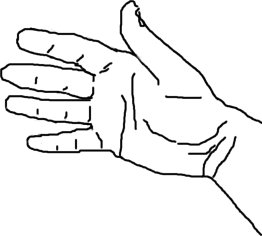
A word file containing the images of the hands may be obtained from the link below. The next step will be to tell the story as a kind of comic strip illustrating the hand movements and the teacher’s dialogue.
http://kn.open.ac.uk/public/document.cfm?documentid=8672
Well, I haven’t finished all my reading today (5 pages short) and it feels like I have not done a lot else. I need to do my first visually displayed episode of the use of gesture by a teacher in explaining graphs. This has involved me having to draw a number of hands in different positions (mostly done previous to this 50 day effort). The way I did this was to copy the position of the hand adopted by the teacher with my own hand and then take a digital photograph of this position. I then imported the image into Paint Shop Pro (ver. 7). I then zoomed it to a largish size and using the paintbrush tool drew an outline of the hand…this was set as a new layer on top of the hand. I then copied this layer and reduced it in size to give a hand. This was quite a difficult process since it is fairly hard to trace a line with the mouse. I have so far drawn about 20+ different hand shapes. I will incorporate these shapes into the story of how the teacher explains the relationship between a time-distance graph that he has drawn on the board and the graph produced as a result of students attempting to emulate the graph with their own movement in front of a motion detector.


A word file containing the images of the hands may be obtained from the link below. The next step will be to tell the story as a kind of comic strip illustrating the hand movements and the teacher’s dialogue.
http://kn.open.ac.uk/public/document.cfm?documentid=8672
Friday, September 01, 2006
Writing a draft of my PhD
From Monday I am going to endeavour to write up the whole of my PhD in draft form. Am I ready for this? When is anyone ready?
The aim is to complete my PhD by the end of the first week in January or thereabouts.
I am going to allow myself 50 days for this process. This will also coincide with an intended period of abstinence from alcohol (this for a variety of reasons including getting my weight down).
At a 80 000 words (80 to 100 thousand being allowed for a PhD) this represents 1600 words a day.
I will also need to read during this period and expect this reading to take between 1.5 and 2 hours a day. I envisage the total number hours required to be of the order of 5 hours a day…giving a total of 250 hours, although more may be needed.
As part of my reading I wish to finish off Where Mathematics Comes From (Lakoff, Nunez, 2000) and Women Fire and Dangerous Things (Lakoff, 1987). In order to complete these within the first 30 days I would have to read 10 and 17 pages per day from each of these books respectively. I have another Lakoff book that I wish to read – Philosophy in the Flesh, or some such title….cannot remember.
The important thing about this process is that the PhD draft does not have to be good…it is a draft but something on which to work and build. Essentially there will be:
Reading
Analysis
Writing
At least I have already made a rough draft of the P chapter.
Wednesday, July 19, 2006
Parallel Processing and Multitasking - Good or Flustering?
The concept of parallel processing has often been talked about, or in other words, multitasking. The underlining message or belief is perhaps that this is some kind of greater efficiency of working. Even I find now that I cannot do without two screens for my computer - it makes it easy to work between programs or documents. Doing several things concurrently is meant to be good.
Where does this concept come from. The alternative idea is that carry on with one task, and that task only, until it is completed! You are not distracted! The job gets done and out the way, whereas with the parallel approach it is more difficult to keep a trace on what you are doing and to finish things, and you simply end up just getting befuddled, confused and flustered, however you avoid the boredom of doged pursuit in the one task approach.
I suspect that for me the idea of parallel processing comes from perceptions of computing and the way that the brain is perceived to work....you can only instantly recall 6 or 7 numbers immediately after they are given to you, therefore the conclusion might be that the brain can parallel process at just about these levels. However, we are talking about numbers here and short term memory, not complex tasks.
There is a sense that if parallel processing does occur is largely automatic or semi-automatic and the skills do not necessarily interfere with each other too much. Driving a car (largely kinesthetic and visual) can be carried on whilst listening to the radio (purely auditory). It is more likely that the parallel processing we talk about in work is simply rapidly shifting to and from different mediums, tools and content, in small chunks rather that co-carrying a number of tasks and activities simultaneously. The danger is that if you try to handle too many of these things simultaneously you might become flustered and in the end focus your energy into one area, or redistribute your time in manageable chunks.
In distance education if students have to handle to many different types of thing more or less concurrently this might become somewhat overwhelming and pose a problem to their learning.
Wednesday, July 12, 2006
Starting my new job
I am now officially three days into my new job - Open Content Initiative - based at the Open University. Things have been a bit hectic with me actually finishing and sending off the revised PhD ugrade document to Bristol University...I just hope now it is Ok. It is amazing how long it has taken me...I think a lot to do with this is the process of just thinking about it...it is also hard to overhaul something and reassemble. Sometimes I think it is easier to create something anew.
I know it has its faults but it has a rhyme and reason and is much more focused. The ideas, especially the philosophies are also interesting and thought provoking.
I am also balancing the ongoing work from my last project at the OU. I hope that there will be significant output from this.
The new job appears to be interesting and it is particularly valuable for me to get an insight into the creative process of producing something large and potentially very significant. As part of my initial role I have the chance to act as researcher in observing the development process by attending all the meetings. This is interesting in that it gives me insights to things from other perspectives such as design, technical implementation, marketing etc. I am a kind of participant observer in all of this.
The Open Content Initiative site will have basically two sides, a learner side - for course content, and a Lab-site where people can create or modify content. That's basically it in brief but I will try to give a more self-contained review later.
Subscribe to:
Posts (Atom)